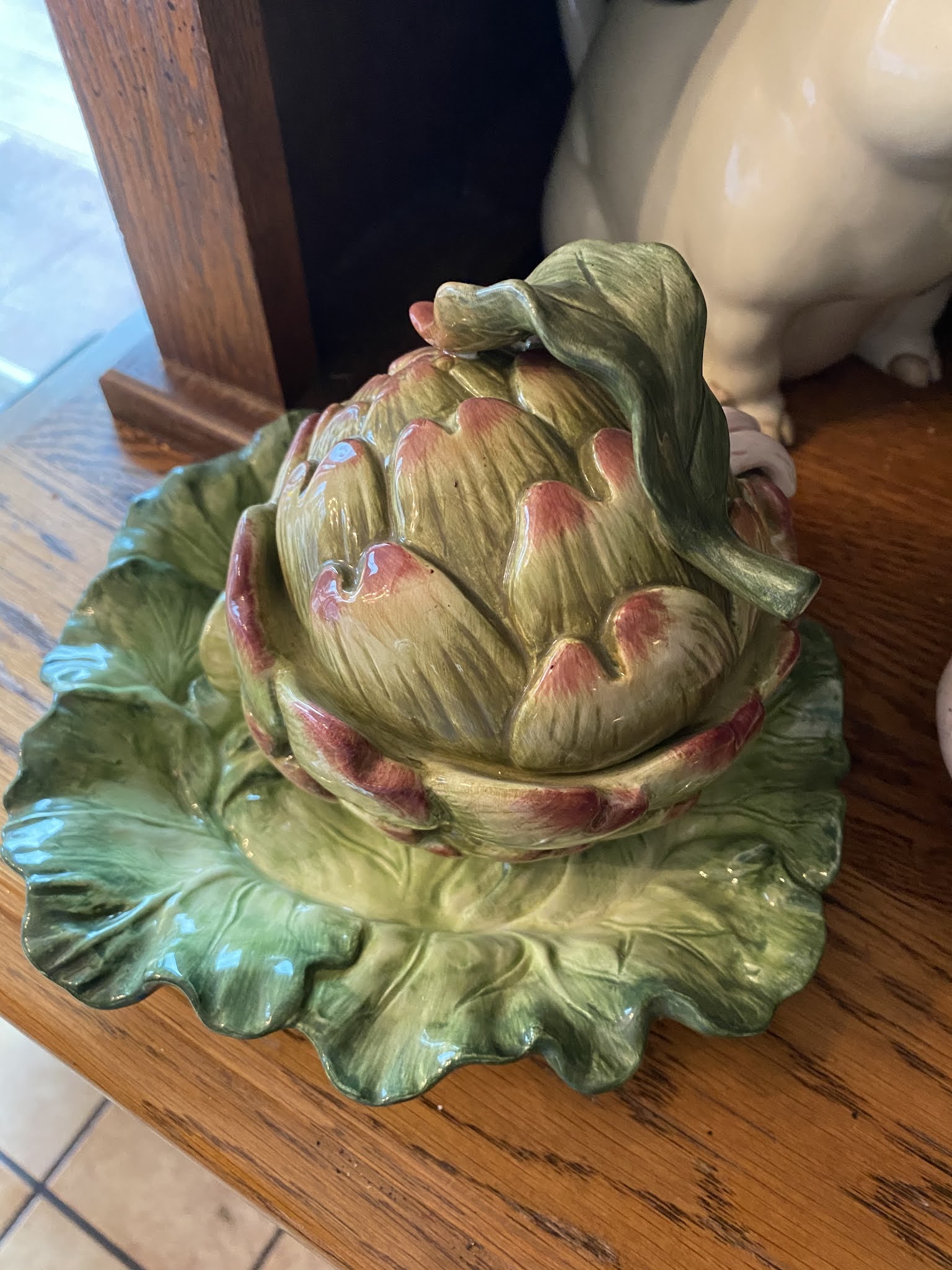
Thanks Wikapedia:
Flow blue (occasionally 'flown blue') is a style of white earthenware, sometimes porcelain, that originated in the Regency era, sometime in the 1820s, among the Staffordshire potters of England. The name is derived from the blue glaze that blurred or "flowed" during the firing process.[1]

Most flow blue ware is a kind of transferware, where the decorative patterns were applied with a paper stencil to often white-glazed blanks, or standard pottery shapes, though some wares were hand painted. The stencils burned away in the kiln. The blue glazes used in flow blue range from gray-blue to sometimes greenish blue, to an inky blue; however the most desirable and sought-after shade is a vivid cobalt blue. Mulberry is another form of flow blue, where the glaze is more purple in hue.
Wedgwood is a fine china, porcelain, and luxury accessories manufacturer that was founded on 1 May 1759[1] by the English potter and entrepreneur Josiah Wedgwood and was first incorporated in 1895 as Josiah Wedgwood and Sons Ltd.[2] It was rapidly successful and was soon one of the largest manufacturers of Staffordshire pottery, "a firm that has done more to spread the knowledge and enhance the reputation of British ceramic art than any other manufacturer",[3] exporting across Europe as far as Russia, and to the Americas. It was especially successful at producing fine earthenware and stonewares that were accepted as equivalent in quality to porcelain (which Wedgwood only made later) but were considerably cheaper.[4]
Wedgwood is especially associated with the "dry-bodied" (unglazed) stoneware Jasperware in contrasting colours, and in particular that in "Wedgwood blue" and white, always much the most popular colours, though there are several others. Jasperware has been made continuously by the firm since 1775, and also much imitated. In the 18th century, however, it was table china in the refined earthenware creamware that represented most of the sales and profits.[5]
In the later 19th century it returned to being a leader in design and technical innovation, as well as continuing to make many of the older styles. Despite increasing local competition in its export markets, the business continued to flourish in the 19th and early 20th centuries, remaining in the hands of the Wedgwood family, but after World War II it began to contract, along with the rest of the English pottery industry.
After buying a number of other Staffordshire ceramics companies, in 1987 Wedgwood merged with Waterford Crystal to create Waterford Wedgwood plc, an Ireland-based luxury brands group. After a 2009 purchase by KPS Capital Partners, a New York-based private equity firm, the group became known as WWRD Holdings Limited, an acronym for "Waterford Wedgwood Royal Doulton". This was acquired in July 2015 by Fiskars, a Finnish consumer goods company.[6]


This is called a "Gone with the Wind" lamp.